
Sara-Claude Hammond invites people to engage with her exhibition through touch. By stimulating the senses, visitors become an integral part of the exhibit.
Hammond is a Montréal-based artist with a focus on sculpture. Her work explores our connection to the environment and what binds us to the earth. She graduated with a Bachelor of Fine Arts from the University of Concordia in 2017 and has a DEC in sculpture from the Maison des Métiers d’art de Québec.
Her most recent exhibit, Activer Les Chants des Cycles, is on display at Skol until April 16.
The centrepiece of Hammond’s exhibit is a large sculpture made of innertubes. It gives the illusion of a mass of feathers and it is one of the artist’s favourite projects as of recent.
The sculpture took almost two years to complete.
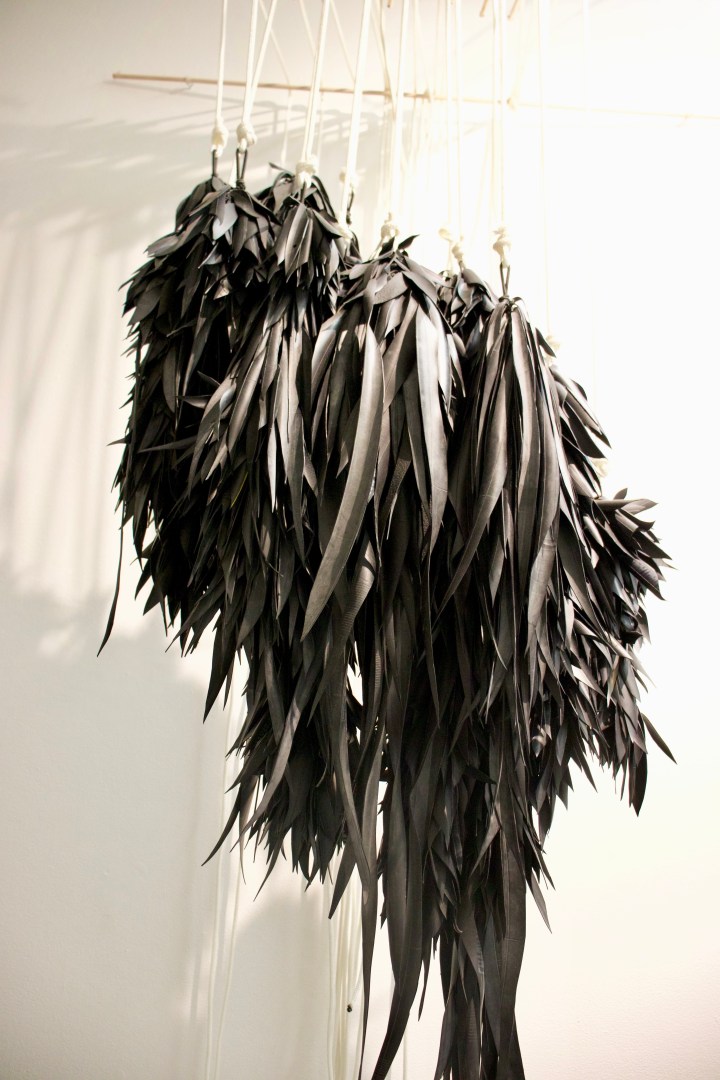
“It was a bit about holding something and letting it go. Like let’s say our fears or anxiety,” said Hammond.
The original goal of the sculpture was to be interactive. A series of pulleys and ropes allow people to make the sculpture “move and dance”. As visitors manipulate the sculpture, the features make a soft noise, stimulating not only the sense of touch but also sound.
Due to COVID-19 restrictions, visitors were not able to interact with the sculpture the way the artist originally intended.
Choosing Materials
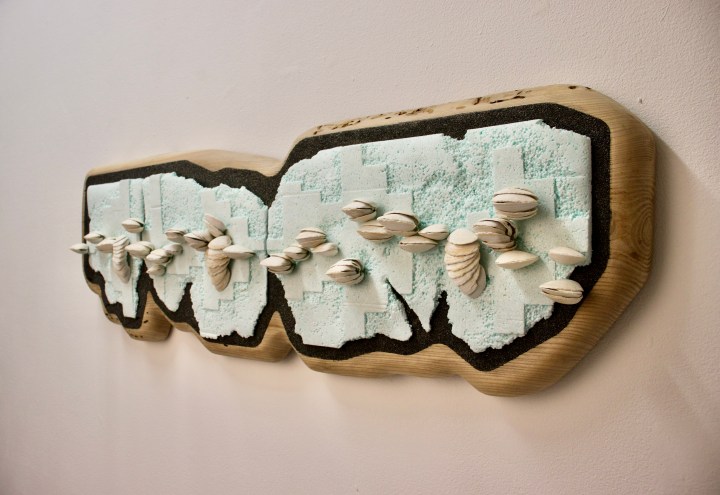
Her second sculpture, which is from the beginning of 2021 plays with the idea of working with synthetic materials versus “matières nobles” or substances that are not synthetic.
“I really like the industrial world and to look at it with an artistic vision,” she said. “It tells a lot about how we talk about our relationship with nature and our environment.”
Hammond loves the 3D aspect of sculpture and working with matter. She said that in the Western world there is plenty of material and that people throw out garbage all the time. She likes working with scraps from the industrial world and recently began playing with paper pulp.
When Hammond went to school for sculpture, there was a focus on the technical approach to woodworking, metalworking and stone carving. While she learned to work with matières nobles, she decided to pursue working with the synthetic matter as well.
“Any material has something to say,” she said. “And that’s what I’m trained to do with the sculptures. So I am really open to any types of material.”
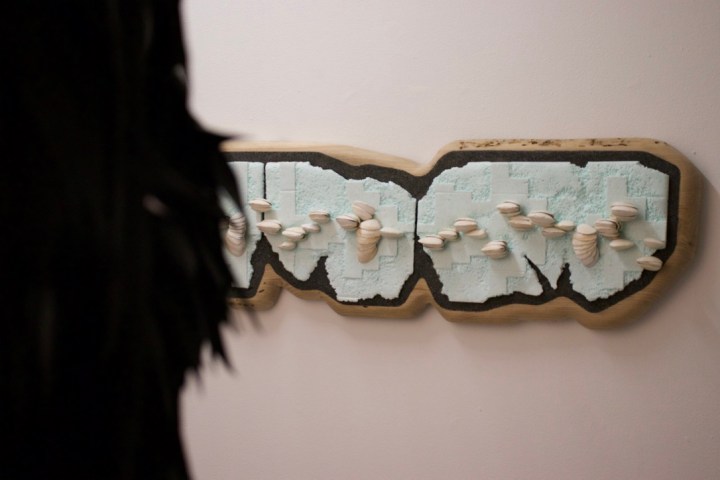
Every piece of the sculpture has a history. She incorporated boards from an ash tree that had been eaten by insects, styrofoam from a home renovation, shells and mica. She said that for this piece, it was really like playing with the contrast of the materials.
“This piece is [also] talking about how nature degrades and then rebuilds itself,” said Hammond. “And that’s a big part of my thought and my work. How nature evolves by itself, it’s autonomous and we as humans always want to manage it and organize it.”
Growing up in the city and the country
While Hammond grew up in Montréal the artist’s family is from Gaspésie and she spent many summers in the region. She explained that she feels a duality between growing up in both the city and the country. While spending time in Montréal, people often mark her a as “countryside girl” but while visiting Gaspésie, she is told she acts like someone from the city.
She said her family’s roots have helped shape her identity and the region’s countryside inspires her art. This mix of identities, she explained, allows her to step back and think about how people perceive the world, emotions and truth.
“We often want to apply some binary interpretation on everything,” she said. “Like if it’s not Hell, it’s paradise and if it’s not black, it’s white. But being from these two places made me realize there’s a big piece in between that is very interesting to play with. I wish we [would] give more space to this interpretation of things instead of just being black or white.”
 Jano Lapin